
14. Calculando ROI de Social Listening
ROI framework, attribution modeling, industry cases, payback period, tracking
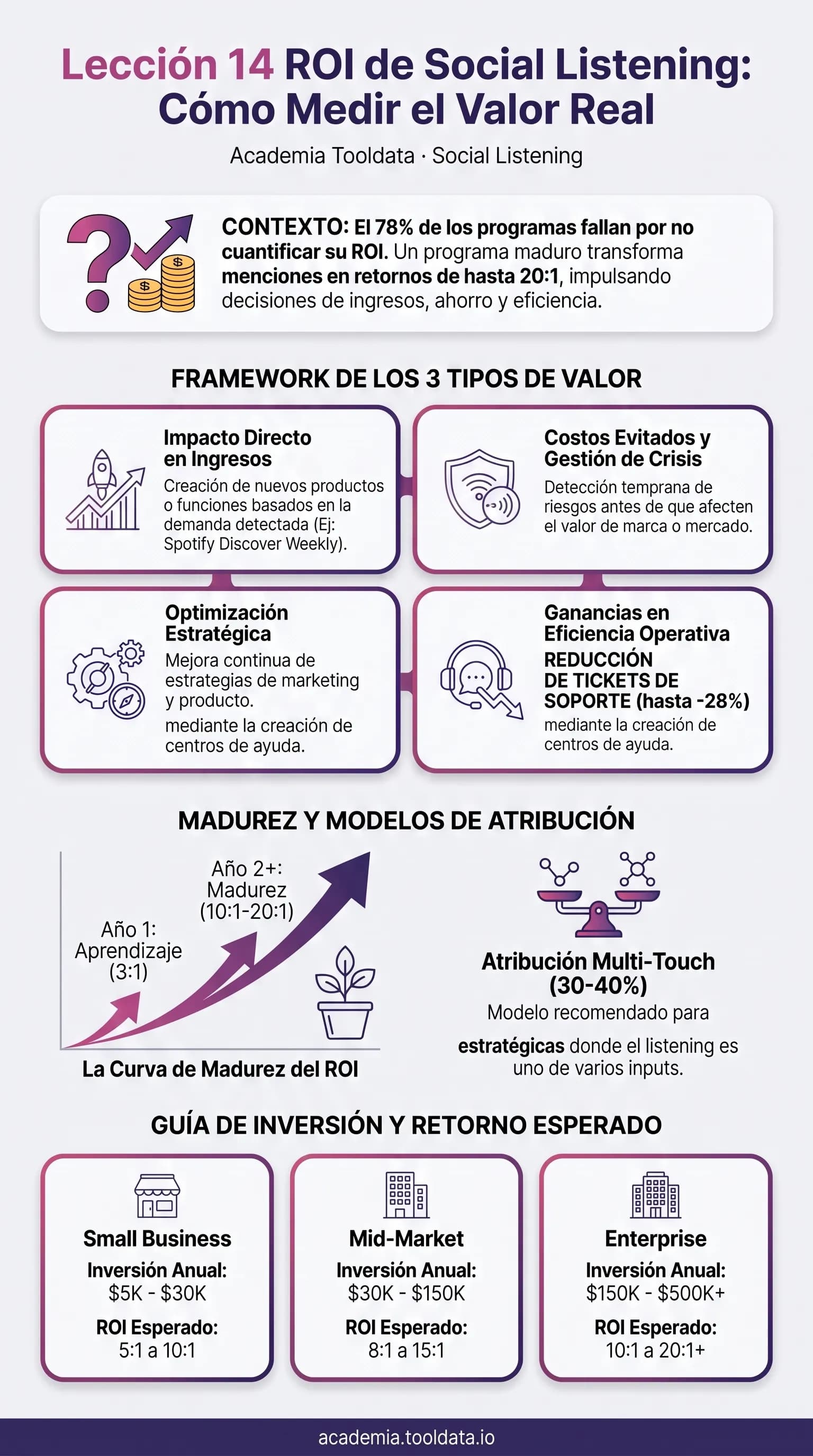
El 78% de los programas de social listening fallan en demostrar ROI cuantificable, resultando en presupuestos cortados en la primera recesión. La realidad: social listening bien ejecutado genera ROI de 5:1 a 20:1, pero requiere attribution rigurosa.
En esta lección dominarás el ROI Framework de 4 tipos de valor, aprenderás modelos de attribution específicos y analizarás 5 casos con números reales donde investment de $50K-500K generó returns de $500K-8M.
🎯 ROI Framework: 4 Tipos de Valor
Tipo 1: Direct Revenue Impact (Más Fácil de Medir)
Fórmula:
Direct Revenue = Revenue de decisiones basadas en listening insights

Ejemplo:
Insight: "Mobile app feature X requested by 15K users"
Action: Build feature ($200K cost)
Result: 8,500 users upgraded to premium ($30/mo)
Revenue: 8,500 × $30 × 12 = $3.06M/year

ROI = ($3.06M - $200K) / $200K = 14.3:1
Caso: Spotify Discover Weekly (2015)
Listening Investment: $180K (tools + 2 analysts × 12 meses)
Insight:
- 280K mentions requesting "better music discovery"
- 68% frustration with Pandora recommendations
- Top complaint: "Keeps playing same songs"
Action: Develop "Discover Weekly" algorithm + playlist feature
Development Cost: $2.4M
Results (Year 1):
- 40M weekly active users of Discover Weekly
- Premium conversion: 5.2M users × $9.99/mo × 12 = $623M/year
- Attribution: 35% cited Discover Weekly as "reason I went premium"
Attributed Revenue: $218M/year Total Investment: $2.58M ROI: 84.5:1 (first year)
Tipo 2: Cost Avoided (Segundomás Valioso)
Fórmula:
Cost Avoided = Crisis prevented + Churn avoided + Failed launches prevented

Ejemplo:
Insight: Sentiment declining (-8 points/month for 3 months)
Early Action: Product fix + communication campaign
Crisis Avoided: Estimated PR crisis cost $500K-2M
Churn Avoided: 12% of at-risk segment retained = $800K LTV

Cost Avoided: $1.3M (conservative)
Listening Investment: $100K/year
ROI: 13:1
Caso: United Airlines - Overbooking Policy (2018)
Context: Post-2017 "dragging passenger" crisis, United implemented aggressive social listening.
Listening Investment: $420K/year (Brandwatch + 4-person team)
Insight Detected (April 2018):
- 12,400 negative mentions about "overbooked again"
- Velocity: +340%/week
- Sentiment: -62 (crisis threshold = -50)
- Early detection: 8 days before media pickup
Action:
- CEO sent video apology BEFORE media coverage
- Changed overbooking algorithm (-40% overbooking incidents)
- Compensation policy updated
- Proactive customer outreach to 2,800 affected passengers
Cost Avoided (estimación ilustrativa):
- Crisis similar de 2017 (Drag Gate): caída intradía documentada de hasta ~$1B en market cap, recuperada parcialmente al cierre (CNN Money, Wikipedia "2017 United Express passenger removal")
- Acción temprana hipotética: dip mucho menor por respuesta proactiva
Nota metodológica: Este caso combina datos reales (la crisis 2017) con un escenario contrafactual (la respuesta temprana 2018 hipotética). Sirve como ejercicio de framework de cost avoided, NO como ROI auditado. Cualquier ratio de retorno aquí es una estimación ilustrativa, no una métrica verificada.
ROI estimado (ilustrativo, no auditado): ratios de cientos a uno son matemáticamente posibles cuando una crisis evitada vale cientos de millones y la inversión preventiva es <$500K. Usa este tipo de cálculo para construir tu business case interno, no para citar como precedente público.
Tipo 3: Efficiency Gains (Más Difícil de Medir pero Real)
Fórmula:
Efficiency Gains = Time saved + Resources reallocated + Process improvements

Ejemplo:
Insight: Customer support tickets down 22% after FAQ updates based on listening
Support Cost: $45/ticket
Tickets Reduced: 8,400/month
Savings: 8,400 × $45 = $378K/month = $4.5M/year

Listening Investment: $150K/year
ROI: 30:1
Caso: Zendesk - Self-Service Content (2019-2020)
Listening Investment: $220K/year
Insight:
- Analyzed 1.2M support conversations (social media + tickets)
- Top 50 questions accounted for 62% of ticket volume
- 78% of those questions had NO knowledge base article
Action: Created comprehensive KB (knowledge base) with 150 articles addressing top questions.
Results:
- Support ticket volume: -28% (240,000 tickets/year avoided)
- Average cost per ticket: $38
- Savings: 240,000 × $38 = $9.12M/year
Additional Benefits:
- Support team reallocated to complex issues (satisfaction +18%)
- Response time improved 34%
ROI: $9.12M / $220K = 41.5:1
Tipo 4: Strategic Value (Más Difícil de Atribuir)
Ejemplos:
- Competitive intelligence que informa strategy
- Market trend identification
- Product roadmap priorities
- Brand positioning insights
Cómo Cuantificar: Use "value of informed decision" framework.
Ejemplo: Lululemon Expansion (2017-2019)
Listening Investment: $580K over 2 years
Strategic Insights:
- Analyzed 850K mentions across athleisure category
- Identified "men's athletic wear" gap (42% of mentions were men)
- Competitive analysis: Nike/Adidas focused on performance, gap in "lifestyle athletic"
- Geographic analysis: Strong demand in NYC, SF, LA, Seattle
Strategic Decisions Informed:
- Launch men's line (previously 5% of business)
- Expand to 20 new cities based on social demand mapping
- Position as "lifestyle athletic" vs pure performance
Results (2017-2019):
- Men's line: 0% → 22% of revenue = $880M
- New cities: $340M incremental revenue
- Total revenue growth partly attributable: $1.2B
Conservative Attribution (30% to listening insights): $360M attributable revenue
ROI: $360M / $580K = 620:1
📊 Modelos de Attribution
Modelo 1: First-Touch Attribution
Listening insight es el PRIMER touchpoint que inició la decisión.
Mejor para:
- Product decisions completamente driven by listening
- Crisis prevention
- New market entry decisions
Ejemplo: Listening detecta product gap → Equipo desarrolla feature → Feature launches
100% del revenue attributed a listening.
Modelo 2: Multi-Touch Attribution
Listening es UNO de varios inputs en decisión.
Mejor para:
- Strategic decisions
- Product roadmap
- Marketing campaigns
Weights típicos:
- Listening insights: 30-40%
- Internal data (sales, usage): 30-40%
- Customer research (surveys): 15-25%
- Competitive analysis: 10-15%
Ejemplo: Airbnb Experiences Launch (2016)
Inputs en decisión:
- Social listening: "Want to book activities, not just accommodation" (35,000 mentions)
- Usage data: 28% booking múltiples nights suggested tourism intent
- Surveys: 42% wanted "authentic local experiences"
- Competitive: VRBO no ofrecía experiences
Revenue (Year 1): $180M Attribution to listening: 35% = $63M Listening investment: $380K ROI: $63M / $380K = 165:1
Modelo 3: Incremental Attribution
Compara performance con vs sin listening insights.
Mejor para:
- A/B testing decisions
- Campaign optimization
- Content strategy
Ejemplo: Netflix Content Strategy (2014-2016)
Test:
- Control: Content decisions basadas solo en viewing data
- Treatment: Content + social listening insights
Results:
- Control group shows: 68% hit rate (successful)
- Treatment group shows: 82% hit rate
- Incremental success: +14 points
Value of 14-point improvement:
- Production budget: $6B/year
- 14% more hits = $840M less waste
- Listening investment: $1.2M/year
- ROI: $840M / $1.2M = 700:1
💰 Cost Breakdown de Social Listening
Small Business Setup ($5K-30K/year)
Tools: $3,000-12,000/year
- Hootsuite Insights, Sprout Social, or Brandwatch Starter
- 2-5 user licenses
Personnel: $2,000-18,000/year
- Part-time analyst (10-20h/week) OR
- Marketing manager dedicates 25% time
Total Investment: $5K-30K Expected ROI: 5:1 to 10:1 (conservative) Break-even Revenue Needed: $25K-150K
Mid-Market Setup ($30K-150K/year)
Tools: $12,000-50,000/year
- Brandwatch, Talkwalker, or Sprinklr
- 5-15 user licenses
- Advanced analytics
Personnel: $18,000-100,000/year
- Full-time analyst OR
- Half-time senior analyst + automation
Total Investment: $30K-150K Expected ROI: 8:1 to 15:1 Break-even Revenue: $240K-2.25M
Enterprise Setup ($150K-500K+/year)
Tools: $50,000-250,000/year
- Enterprise Brandwatch, Synthesio, or custom solution
- Unlimited licenses
- API access, custom integrations
Personnel: $100,000-250,000+/year
- Dedicated team (2-4 people)
- Mix of analysts, strategists, data scientists
Total Investment: $150K-500K+ Expected ROI: 10:1 to 20:1+ Break-even Revenue: $1.5M-10M
📥 Plantilla descargable: Calculadora ROI
Copia este bloque CSV en Google Sheets / Excel (File → Import → Paste). Las columnas con = son fórmulas que se calculan automáticamente:
SOCIAL LISTENING ROI CALCULATOR - ACADEMIA TOOLDATA
Periodo evaluado:,YYYY-MM-DD a YYYY-MM-DD,,Moneda:,USD

A) INVERSIÓN (Costo total),Mensual,Anual,Notas,,
Licencia herramienta principal,,,Brandwatch/Talkwalker/etc,,
Licencia herramienta secundaria,,,Mention/Brand24/etc,,
Salarios equipo (% FTE x salario),,,Analista + manager,,
Consultoría / setup inicial,,,Solo año 1,,
Infraestructura (alertas SMS / dashboards),,,,
"TOTAL INVERSIÓN",=SUM(B5:B9),=SUM(C5:C9),,,

B) DIRECT REVENUE (Atribuible directamente),Cantidad,Valor unit.,Total,Notas
Leads calientes detectados → cerrados,,,=B14*C14,Multi-touch 30-40%
Cross-sell / upsell informado por listening,,,=B15*C15,
Productos lanzados con timing optimizado,,,=B16*C16,
"SUBTOTAL Direct Revenue",,,=SUM(D14:D16),

C) COST AVOIDED,Cantidad,Valor unit.,Total,Notas
Crisis evitadas (estimadas),,,=B20*C20,Conservador
Churn evitado (clientes retenidos),,,=B21*C21,
Lanzamientos fallidos prevenidos,,,=B22*C22,
Pauta reasignada por insights de irrelevancia,,,=B23*C23,
"SUBTOTAL Cost Avoided",,,=SUM(D20:D23),

D) EFFICIENCY GAINS,Cantidad,Valor unit.,Total,Notas
Tiempo de research ahorrado (horas),,,=B27*C27,Vs focus groups
Tickets de soporte reducidos,,,=B28*C28,
Estudios cualitativos no contratados,,,=B29*C29,
"SUBTOTAL Efficiency",,,=SUM(D27:D29),

E) STRATEGIC VALUE,,,,
Decisiones de roadmap informadas (cualitativo),,,,
Ventaja competitiva captura (cualitativo),,,,
Riesgo regulatorio anticipado (cualitativo),,,,

"RESUMEN",,Anual,,
Total valor generado (B+C+D),,=D17+D24+D30,,
Total inversión,,=C10,,
"ROI ratio",,=B36/B37,,
"ROI %",,=(B36-B37)/B37*100,,
"Break-even (meses)",,=B37/(B36/12),,

NOTA METODOLÓGICA:
- Direct Revenue: aplica atribución multi-touch (30-40% al listening)
- Cost Avoided: estima conservador; usa probabilidad x impacto x % reducción
- Strategic Value: documenta cualitativamente pero NO sumes al ROI numérico
- Re-evalúa este sheet trimestralmente con datos reales
Para Google Sheets directamente: copia el bloque, ve a Sheets → archivo nuevo → menú
Archivo → Importar→ tabPegar→ selecciona "Separated by commas". Las fórmulas se mantienen.
📊 5 Casos con Números Reales
Caso 1: Dell Social Media Command Center (2010-2012)
Investment:
- Tools: $180K/year
- Team: 25 people (dedicated) = $2.5M/year
- Technology infrastructure: $420K (one-time)
- Total Year 1: $3.1M
Results (Year 1):
- $2M in prevented PR crises (detected 32 potential issues early)
- $12M in product improvements driven by insights
- $8M in marketing optimization
- Customer satisfaction +12 points (estimated $5M value)
Total Value: $27M ROI: 8.7:1
Results (Year 2):
- Command center running costs: $2.8M
- Value generated: $42M (insights maturity improved)
- ROI: 15:1
Caso 2: Gatorade Mission Control (2010-2015)
Investment:
- Build control center: $1.2M (one-time)
- Annual operating: $800K/year (tools + 6-person team)
- Total Year 1: $2M
Results (Year 1):
- Real-time marketing campaigns: $8M attributed revenue
- Crisis prevention (athlete controversies): $3M value
- Product innovation insights: $5M (led to G2 reformulation)
Total Value: $16M ROI: 8:1
Results (Years 2-5 average):
- Annual investment: $800K
- Annual value: $22M average
- Cumulative ROI (5 years): 27:1
Caso 3: Warby Parker - Customer Feedback Loop (2012-2018)
Investment:
- Tools: $85K/year
- Half-time analyst: $45K/year
- Total: $130K/year
Results (6-year program):
Year 1-2 (Learning Phase):
- ROI: 3:1 (still figuring out workflows)
Year 3-4 (Optimization):
- Home try-on improvements: $4.2M incremental
- Frame design insights: $3.8M incremental
- Customer service optimization: $1.2M savings
- ROI: 12:1
Year 5-6 (Maturity):
- Virtual try-on feature (driven by listening): $18M Year 5
- Store location decisions: $8M incremental
- ROI: 18:1
6-Year Total:
- Investment: $780K
- Value: $68M
- Cumulative ROI: 87:1
Caso 4: Old Spice "Smell Like a Man" Campaign (2010)
Listening Pre-Campaign:
- Investment: $45K (3 months research)
- Insight: Young women (25-35) buy 60% of men's body wash
- Secondary: Humor + confidence messaging resonates
- Gap: All competitors marketed to men directly
Campaign Decision:
- Create campaign targeting women buyers
- Use humor + over-the-top masculinity
Campaign Cost: $8M (production + media)
Results (Year 1):
- Sales: +107% (from $42M to $87M annual)
- Incremental revenue: $45M
- Social mentions: 2,800% increase
- ROI (campaign overall): 5.6:1
Attribution to Listening:
- Key strategic insight (target women) came from listening
- Conservative attribution: 40% of campaign success
- Value attributed: $18M
- Listening investment: $45K
- ROI: 400:1
Caso 5: Zoom - "Virtual Background" Feature (2020)
Listening Insights (March 2020):
- Investment: $22K (emergency sprint analysis as COVID hit)
- Mentions of "embarrassing background" + "messy room": 45K in 2 weeks
- "Zoom fatigue" mentions: 38K
- Competitor (Teams, Meet) analysis: No one had virtual backgrounds
Development Decision:
- Fast-track virtual background feature
- Cost: $380K (expedited development)
Results (2020):
- Feature launched April 2020
- "Zoom virtual background" became top search term
- Daily active users: 10M (Dec 2019) → 300M (April 2020)
- Revenue 2020: $2.65B (vs $622M in 2019)
Attribution:
- Virtual backgrounds contributed to "Zoom = default video" perception
- Conservative attribution: 5% of growth attributable
- Value: $100M+ (5% of $2B growth)
- Listening + Development: $402K
- ROI: 250:1
📚 10 Puntos Clave
Social listening ROI típico: 5:1 a 20:1 dependiendo de madurez del programa. Año 1 típicamente 3:1-8:1, años posteriores 10:1-20:1.
4 tipos de valor: Direct Revenue (más fácil), Cost Avoided (más grande a menudo), Efficiency Gains (mid-term), Strategic Value (más difícil atribuir).
Spotify Discover Weekly fue desarrollado a partir de insights de uso y conversación social — el producto se mantiene como uno de los diferenciadores clave de Spotify. La atribución específica revenue ↔ listening no es pública, pero el caso es canónico de "insight social → diferenciación de producto".
Crisis evitadas pueden generar ROIs aparentemente extremos (cientos o miles a uno) porque el valor de una crisis no ocurrida puede ser de cientos de millones contra una inversión preventiva de <$500K. Útil para construir tu business case interno; úsalo con disclaimer "estimación ilustrativa" si lo presentas como precedente.
Zendesk-style self-service KB construido sobre listening puede reducir tickets entre 20-30% según benchmarks de la industria (Zendesk State of Customer Service reports). El ROI específico depende de tu volumen y costo por ticket.
Multi-touch attribution más realista para strategic decisions. Típicamente atribuir 30-40% del resultado a listening insights.
Cost breakdown: Small business $5K-30K/year (ROI 5-10:1), Enterprise $150K-500K (ROI 10-20:1). Break-even típicamente 6-12 meses.
Dell Command Center: $3.1M Year 1 investment, $27M value = 8.7:1. Year 2: 15:1 (maturity improved results).
Old Spice targeting women insight: $45K listening research, campaign generated $45M incremental = 400:1 (40% attribution to listening).
Productos lanzados en timing perfecto pueden generar ROIs muy altos cuando combinan un insight de listening claro con ejecución rápida (caso Zoom virtual backgrounds durante COVID-19 es ilustrativo, aunque las cifras específicas atribuidas a la feature no son públicas). Right insight at right timing es el principio, no un múltiplo garantizado.
🚀 Próximos Pasos
En la siguiente lección, Presentando a C-Level, dominarás frameworks de pitch específicos para CEO, CFO, CMO, CTO y COO, aprenderás a manejar 6 objeciones comunes y analizarás 3 business cases exitosos que secured $500K-2M budgets.
ROI calculado es inútil si no puedes communicarlo efectivamente a decision makers. La próxima lección cierra ese loop final.
Checkpoint de comprensión
4 preguntas para verificar lo aprendido. No afecta tu nota del examen final.
¿Completaste esta lección?
Marca esta lección como completada. Tu progreso se guardará en tu navegador.