16. Privacidad y GDPR en Social Listening
Regulatory landscape, compliance, data handling, breach response, ethics
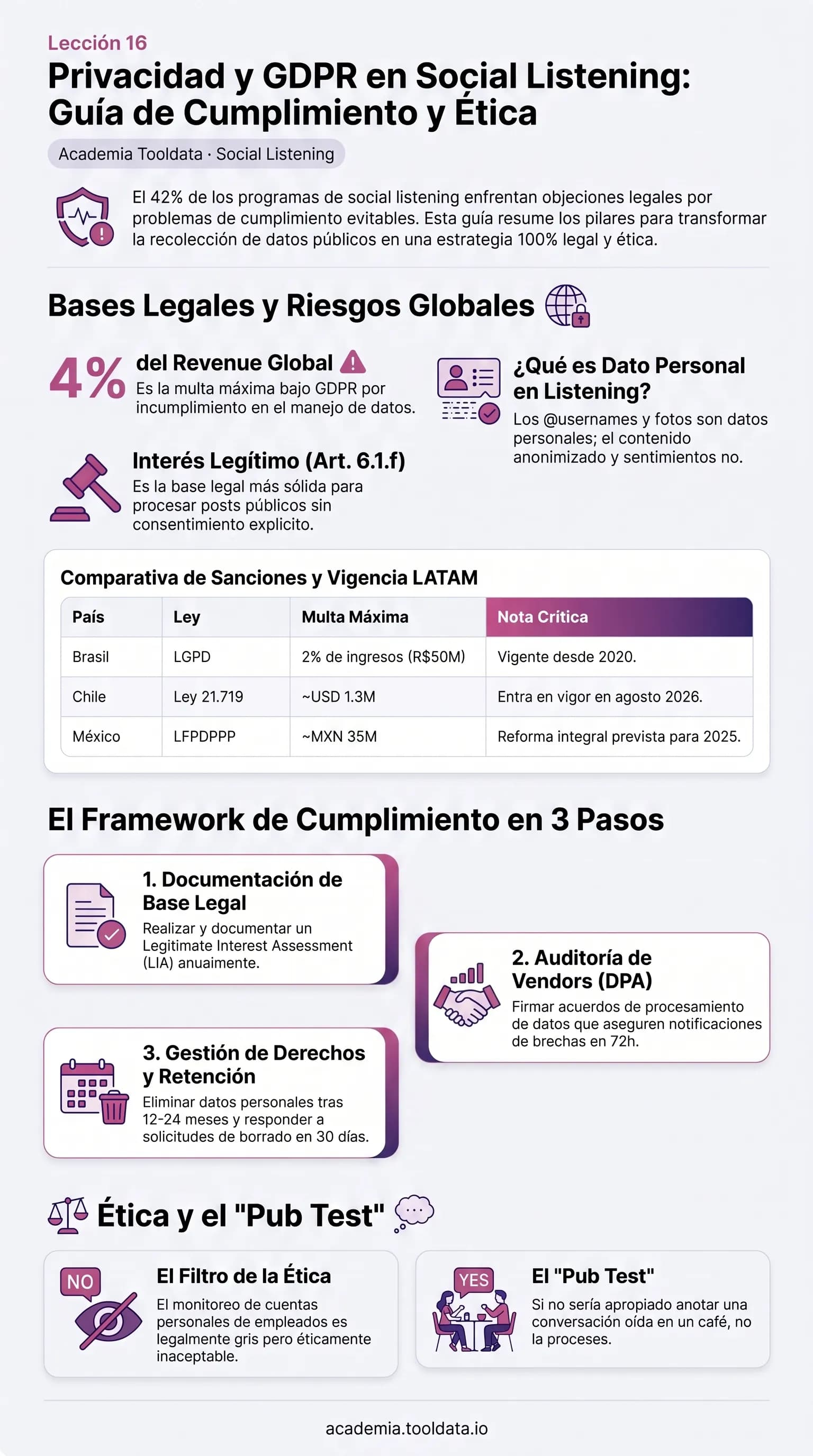
El 42% de los programas de social listening enfrentan objeciones legales por compliance issues evitables. Sin embargo, social listening bien ejecutado es 100% legal bajo GDPR, CCPA y LGPD cuando sigues los frameworks correctos.
En esta lección final dominarás el regulatory landscape global, aprenderás el framework de compliance específico para social listening, analizarás 4 casos legales que definieron límites y completarás un audit checklist de 50 puntos para asegurar que tu programa es legal, ético y sustainable.
🌍 Regulatory Landscape Global
GDPR (General Data Protection Regulation) - EU
Vigente: Mayo 2018 Alcance: Cualquier empresa procesando data de ciudadanos EU Penalidades: Hasta €20M o 4% de revenue global anual (lo mayor)
Principios Clave:
Lawfulness, Fairness & Transparency
- Procesamiento debe tener base legal
- Data subjects deben saber cómo usas su data
- No puedes usar data de formas inesperadas
Purpose Limitation
- Solo puedes usar data para propósito específico declarado
- Listening para "business insights" es propósito válido
- No puedes usar listening data para marketing directo sin consent
Data Minimization
- Solo recolecta data necesaria
- No almacenes PII (Personal Identifiable Information) sin razón
- Anonymize cuando posible
Accuracy
- Data debe ser accurate y actualizada
- Corregir errors cuando descubiertos
Storage Limitation
- No guardes data más tiempo del necesario
- Social listening típicamente 6-24 meses es razonable
Integrity & Confidentiality
- Protección contra unauthorized access
- Encryption, access controls
Bases Legales para Social Listening:
Opción 1: Legitimate Interest (Artículo 6(1)(f))
Definición: Puedes procesar data sin consent si tienes "legitimate interest" que no infringe derechos del data subject.
Social Listening Califica Porque:
- Business insights de datos públicos = legitimate interest
- No hay expectativa de privacidad en posts públicos
- Procesamiento es minimal (aggregated insights, no targeting individual)
Debes Demostrar:
- Tienes interés legítimo (business intelligence)
- Processing es necesario para ese interés
- Balanceas tu interés vs. derechos de individuals
Opción 2: Public Data Exception (Recital 47)
GDPR recognizes que data "made manifestly public by the data subject" puede procesarse sin consent.
Social Listening de Posts Públicos: ✅ Legal: Analyze tweets públicos para brand sentiment ✅ Legal: Monitor LinkedIn posts sobre tu industria ❌ Ilegal: Scrape Facebook private groups sin permission
CCPA (California Consumer Privacy Act) - US
Vigente: Enero 2020 Alcance: Empresas with CA customers ($25M+ revenue, o 50K+ consumers, o 50%+ revenue from selling data) Penalidades: $2,500 - $7,500 por violación
Diferencias vs GDPR:
Opt-Out vs Opt-In
- CCPA: Consumidores pueden opt-out de "sale" de data
- GDPR: Requieres opt-in para processing
Definición de "Sale"
- CCPA define "sale" muy ampliamente
- Social listening que comparte insights con third parties podría calificar
- Solución: Clarifique que no "vendes" data, solo usas para internal insights
Right to Know
- Consumidores pueden request qué data tienes sobre ellos
- Social listening: Mantén logs de data sources, methods
LGPD (Lei Geral de Proteção de Dados) - Brazil
Vigente: Septiembre 2020 Alcance: Cualquier empresa procesando data de ciudadanos brasileños Penalidades: Hasta 2% de revenue (max R$50M por violación)
Similar a GDPR:
- Requiere lawful basis
- Right to access, correction, deletion
- Data protection officer para large-scale processing
Social Listening:
- Mismos principios que GDPR aplican
- "Legitimate interest" valid basis
- Public data exemption aplica
Marcos regulatorios LATAM (no solo Brasil)
| País | Ley | Vigencia | Multa máxima | Autoridad |
|---|---|---|---|---|
| Brasil | LGPD | 2020 | 2% de revenue (máx R$50M) | ANPD |
| México | LFPDPPP (en revisión hacia LGPDPPSO) | 2010 / reforma 2025 | Hasta 320.000 UMA (~MXN 35M) | INAI / Secretaría de Anticorrupción |
| Chile | Ley 19.628 (en reforma hacia Ley 21.719, vigente 2026) | 1999 / 2026 | Hasta UTM 20.000 (~USD 1.3M) | Agencia de Protección de Datos (nueva, 2026) |
| Argentina | Ley 25.326 | 2000 | Hasta ARS 5M | AAIP |
| Colombia | Ley 1581/2012 | 2012 | Hasta 2.000 SMMLV (~COP 2.6B) | SIC |
| Perú | Ley 29733 | 2011 | Hasta 100 UIT (~PEN 535K) | ANPD |
Crítico para 2026: Chile estrenará la Ley 21.719 (su "GDPR chileno") en agosto 2026, con sanciones significativamente más altas, derecho a oposición específico para profiling y la creación de la Agencia de Protección de Datos Personales. Si operas en Chile, esta ley redefine el riesgo regulatorio de social listening hacia consumidores chilenos. La diferencia con la Ley 19.628 vigente es enorme — desde "casi sin enforcement" hasta multas de hasta USD 1.3M por infracción.
Caso LATAM relevante: Globant — Hackeo Lapsus$ (marzo 2022)
Aunque no es estrictamente un caso de social listening, el hackeo de Globant (la mayor empresa de servicios IT con sede en LATAM) por el grupo Lapsus$ el 30 de marzo de 2022 es referencia obligatoria para entender por qué el compliance de seguridad y privacidad importa en la región.
- Lapsus$ publicó ~70 GB de código fuente y credenciales del stack Atlassian de Globant
- Los archivos mostraban carpetas con nombres de clientes globales (Apple, Facebook/Meta, DHL, BNP Paribas, Citibanamex, Banco Galicia)
- Globant presentó 8-K ante la SEC el mismo día — manejo de crisis financiera + comunicación pública vía Twitter
- Lapsus$ criticó públicamente las "poor security practices" (contraseñas reutilizadas) — el ataque inicial fue por credenciales débiles
Relevancia para social listening:
- Twitter fue la fuente de verdad pública durante la crisis — analistas de seguridad, inversionistas y clientes obtenían updates por @Globant
- El equipo de social de Globant tuvo que rastrear desinformación (rumores sobre clientes filtrados que no estaban en el dump) tanto como comunicar oficialmente
- Lección regulatoria: bajo LGPD/Ley 19.628/Ley 25.326, una filtración de credenciales de clientes activa obligaciones de notificación a autoridades en 72 horas (similar a GDPR)
Fuentes verificables:
🔍 Qué es "Personal Data" en Context de Social Listening
Definición GDPR de Personal Data
"Any information relating to an identified or identifiable natural person"
Ejemplos:
- ✅ Nombre real
- ✅ Username (si linkable a persona real)
- ✅ Email address
- ✅ IP address
- ✅ Location data
- ✅ Photo/video de persona
- ❌ Anonymous aggregated statistics
Social Listening: Qué Califícomo Personal Data
| Data Type | Es Personal Data? | Almacenable Sin Consent? | Notes |
|---|---|---|---|
| Tweet content | ❌ No (si anonymized) | ✅ Sí | Remove @username, store solo texto |
| @username | ⚠️ Sí | ⚠️ Condicional | Almacenar como hash or ID |
| Profile photo | ✅ Sí | ❌ No | No descargues/almacenes |
| Location (general) | ⚠️ Depende | ⚠️ Condicional | "California" OK, "123 Main St" NO |
| Sentiment score | ❌ No | ✅ Sí | Aggregated insight |
| Follower count | ❌ No | ✅ Sí | Public metric |
Best Practice: Anonymization Framework
Nivel 1: Pseudonymization (Minimum)
Original: "@JohnDoe tweeted: I love this product!"
Pseudonymized: "User_4f8a2c tweeted: I love this product!"
Nivel 2: Content Only (Better)
Original: "@JohnDoe tweeted: I love this product!"
Anonymized: "I love this product!" [no user identifier]
Nivel 3: Aggregated Insights (Best)
Original: 1,200 tweets saying positive things
Aggregated: "Sentiment: 78% positive, sample size 1,200"
Recomendación: Nivel 2 o 3 para compliance máximo.
✅ GDPR Compliance Framework para Social Listening
Paso 1: Legal Basis Documentation
Template de Legitimate Interest Assessment (LIA):
# LEGITIMATE INTEREST ASSESSMENT

## Our Legitimate Interest
Business intelligence and market research to:
- Improve products based on customer feedback
- Monitor brand reputation
- Identify market trends
- Competitive intelligence

## Necessity Test
Social listening is necessary because:
- Surveys/focus groups solo capturan small sample
- Real-time insights impossible con traditional methods
- Cost-effective vs. alternatives
- Provides insights not available elsewhere

## Balancing Test
Our interest (business insights) vs Data Subject rights:

Data Subject Impact: LOW
- We only analyze public posts (no privacy expectation)
- Data is anonymized/aggregated
- No individual targeting or profiling
- No automated decision-making affecting individuals

Our Legitimate Interest: HIGH
- Essential for business competitiveness
- Improves products → benefits consumers
- Prevents crises → protects stakeholders

Conclusion: Our legitimate interest outweighs minimal impact on data subjects.

## Safeguards Implemented
1. Only public data analyzed
2. Anonymization of all identifiers
3. Aggregation before reporting
4. No re-identification attempts
5. Data retention limited to 12 months
6. Right to erasure process established

## Review Date
Annually or upon regulatory changes
Paso 2: Privacy Policy Updates
Include en tu Privacy Policy:
## Social Media Monitoring

We use social listening tools to monitor public conversations about our brand, products, and industry.

What we collect:
- Publicly posted content mentioning our brand or keywords
- Public sentiment and opinions
- Aggregated trends and statistics

How we use it:
- Improve products and services
- Monitor brand reputation
- Identify market trends
- Customer support (responding to public mentions)

Legal basis: Legitimate business interest (GDPR Article 6(1)(f))

Your rights:
- Request deletion of your data: privacy@company.com
- Opt-out: Make your social profiles private
Paso 3: Data Processing Agreement (DPA) con Vendors
Checklist para Social Listening Tool Vendor:
- SOC 2 Type II certified
- GDPR-compliant (documented)
- DPA signed covering:
- Vendor is data processor, you are controller
- Vendor follows your instructions only
- Sub-processors disclosed
- Security measures documented
- Data breach notification (72 hours)
- Assistance with data subject requests
- Data deletion upon contract termination
Top GDPR-Compliant Tools:
- Brandwatch: ✅ GDPR certified, EU data centers
- Talkwalker: ✅ GDPR certified, EU data centers
- Sprinklr: ✅ GDPR certified, global compliance
- Hootsuite: ✅ GDPR certified
Paso 4: Data Subject Rights Management
Right to Erasure ("Right to be Forgotten"):
Process:
- Individual requests deletion via privacy@company.com
- Verify identity (prevent false requests)
- Check if data exists in listening database
- Delete within 30 days (GDPR requirement)
- Confirm deletion to individual
Realistic Expectations:
- You can delete from YOUR database
- You CANNOT delete from source (Twitter, Facebook - that's their responsibility)
- You CANNOT control third-party tools' caches (work with vendor)
Average Requests: <5 per year for typical B2B company (very rare)
Paso 5: Data Retention Policy
Framework:
Data Type | Retention Period | Rationale
----------|-----------------|----------
Raw social posts | 0 months | Immediate anonymization
Anonymized content | 12 months | Trend analysis
Aggregated insights | 24 months | Historical comparison
Reports/analysis | 36 months | Business records
Personal identifiers | 0 months | Not stored
Automated Deletion: Set up automated processes to delete data >retention period.
🚨 4 Casos Legales Que Definieron Límites
Caso 1: hiQ Labs vs LinkedIn (US, 2017-2022)
Context: hiQ scraped LinkedIn public profiles for analytics. LinkedIn blocked access, claiming CFAA (Computer Fraud and Abuse Act) violation.
hiQ Argument: Public data = no privacy expectation, scraping is legal.
LinkedIn Argument: Even public data has protections. User agreement prohibits scraping.
Result (2022 Final): Ninth Circuit ruled FOR hiQ:
- Public data on internet generally scrapable
- CFAA doesn't prohibit scraping public data
- LinkedIn can't use CFAA to block scraping
Impact para Social Listening: ✅ Scraping public social media data is legal (US law) ⚠️ Terms of Service violations could still have consequences ✅ European courts may rule differently under GDPR
Caso 2: Facebook Ireland vs Austrian Privacy Advocate (EU, 2020)
Context: Max Schrems (privacy advocate) challenged Facebook's data transfers to US under Privacy Shield.
Court Ruling (Schrems II): Privacy Shield invalidated. EU data cannot transfer to US without adequate safeguards.
Impact para Social Listening:
- If vendor stores data in US, ensure Standard Contractual Clauses (SCCs)
- Prefer vendors with EU data centers for EU data
- Document transfer mechanisms
Practical:
- Brandwatch: EU data center option ✅
- Sprinklr: EU data center option ✅
- Hootsuite: Primarily Canadian/US servers ⚠️
Caso 3: German Court vs Facebook "Like" Button (Germany, 2019)
Context: Fashion company embedded Facebook Like button on website. Court ruled website operator jointly responsible for Facebook's data collection via button.
Ruling: Website operator is joint controller with Facebook because:
- Button collects data (IP address, etc.)
- Website benefits from data collection (social proof)
- Website must inform visitors and get consent
Impact para Social Listening: ✅ Direct impact: Minimal (you're not embedding tracking) ⚠️ Indirect lesson: If you embed social feeds on website, you may need consent
Workaround: Don't embed live social feeds without consent mechanism.
Caso 4: Google Analytics Illegal in France/Austria (EU, 2022)
Context: French and Austrian DPAs ruled Google Analytics violates GDPR because:
- Data transfers to US (post-Schrems II)
- Insufficient safeguards
- Risk of US government surveillance
Ruling: Websites using Google Analytics without consent are non-compliant.
Impact para Social Listening: Direct impact NONE (different context), but lesson:
- US-based tools require extra scrutiny for EU compliance
- EU data should ideally stay in EU
- SCCs alone may not be sufficient
For Social Listening: Choose vendors with EU data residency options if processing EU citizen data.
🛡️ Ethical Boundaries Beyond Legal Compliance
What's Legal but Potentially Unethical
Scenario 1: Monitoring Employee Personal Accounts
Legal: Probably (if public posts) Ethical: ❌ NO
Why Avoid:
- Chilling effect on free speech
- Damages trust
- Legal risks (labor law, privacy torts)
- Reputational damage if discovered
Best Practice: Only monitor brand/company-related mentions, not individuals.
Scenario 2: Influencer Background Checks
Legal: Yes (public data) Ethical: ⚠️ Gray area
Acceptable:
- Check for brand safety (controversial past posts)
- Verify authenticity (follower quality)
Unacceptable:
- Invasive personal history digging
- Using information for discrimination
- Stalking-like behavior
Best Practice: Limit to professional/brand-relevant checks, document process.
Scenario 3: Political Opinion Tracking
Legal: Yes (public posts) Ethical: ⚠️ Use cautiously
Acceptable:
- Understand political sentiment IF relevant to your industry (e.g., policy changes affecting pharma)
Unacceptable:
- Track employee political views
- Use for hiring/firing decisions
- Sell political data to third parties
Best Practice: Aggregate only, never individual political profiling.
Ethical Framework: "The Pub Test"
Question: "If I overheard this conversation in a public space (pub, coffee shop), would it be appropriate for me to:
- Listen? → Social Listening
- Take notes? → Data Collection
- Tell others? → Data Sharing
- Act on it? → Decision Making"
If answer is YES to all, proceed. If NO to any, reconsider.
✅ 50-Point Compliance Audit Checklist
Legal Basis (10 points)
-
- Legitimate Interest Assessment documented
-
- Legal basis disclosed in Privacy Policy
-
- LIA reviewed annually
-
- Legal team approved listening program
-
- Compliance with GDPR (if EU data)
-
- Compliance with CCPA (if CA data)
-
- Compliance with LGPD (if Brazil data)
-
- No sensitive data categories processed (health, religion, etc.)
-
- Balancing test shows minimal data subject impact
-
- Purpose clearly defined and limited
Data Collection (10 points)
-
- Only public data collected
-
- No private messages/groups monitored
-
- No children's data (<16) intentionally collected
-
- Data minimization principle applied
-
- Collection limited to business-relevant topics
-
- No PII stored beyond necessary
-
- Source attribution maintained (which platform)
-
- Collection methods documented
-
- No unauthorized API access
-
- Platform Terms of Service compliance verified
Data Processing (10 points)
-
- Anonymization/pseudonymization implemented
-
- Aggregation before reporting
-
- No individual profiling for automated decisions
-
- No re-identification attempts
-
- Data quality checks in place
-
- Error correction procedures exist
-
- Access controls implemented (role-based)
-
- Audit logs maintained
-
- Processing activities documented
-
- Purpose limitation respected (no scope creep)
Vendor Management (10 points)
-
- Data Processing Agreement signed
-
- Vendor is GDPR-compliant (if applicable)
-
- Vendor is SOC 2 certified
-
- Sub-processors disclosed
-
- Data location known (US, EU, etc.)
-
- Standard Contractual Clauses in place (if EU-US transfer)
-
- Vendor security measures documented
-
- Breach notification SLA agreed (72 hours)
-
- Contract includes data deletion terms
-
- Vendor compliance reviewed annually
Data Subject Rights (10 points)
-
- Right to erasure process documented
-
- Privacy contact email public (privacy@company.com)
-
- Identity verification process for requests
-
- 30-day response time capability
-
- Request logging system in place
-
- Deletion from listening database possible
-
- Opt-out instructions provided
-
- Complaints procedure exists
-
- DPO appointed (if required by size/scope)
-
- Data subject rights communicated in Privacy Policy
Scoring
- 45-50 points: ✅ Excellent compliance
- 35-44 points: ⚠️ Good, but address gaps
- 25-34 points: ⚠️ Risk exists, immediate action needed
- <25 points: 🚨 High compliance risk, pause program until fixed
📚 10 Puntos Clave Finales
Social listening de posts públicos es 100% legal bajo GDPR usando "legitimate interest" basis (Article 6(1)(f)) si demuestras minimal impact en data subjects.
GDPR penalties hasta €20M o 4% revenue global. CCPA: $7,500/violation. LGPD: 2% revenue. Compliance no es opcional.
Personal data incluye usernames si linkables a persona real. Best practice: Anonymize inmediatamente (User_4f8a → aggregated insights).
hiQ vs LinkedIn (2022): Scraping public data es legal en US pero Terms of Service violations pueden tener consecuencias. EU courts pueden diferir.
Schrems II (2020) invalidó Privacy Shield. EU data a US requiere Standard Contractual Clauses + safeguards adicionales. Prefer EU data centers.
Legitimate Interest Assessment (LIA) debe documentarse showing: 1) Your interest, 2) Necessity, 3) Balancing test. Review anualmente.
Data retention: 12 meses para content, 0 para PII. Automated deletion crítico. Never store personal identifiers long-term.
Right to erasure requests: <5/year típicamente pero process debe existir. Respond en 30 días, delete from YOUR database.
Ethical boundaries > legal minimums. "Pub Test": Si no sería apropiado usar conversación overheard en público, no lo hagas con social data.
50-point audit checklist: Minimum 35/50 para safe operation. <25 = high risk, pause program. Review quarterly.
🎯 Próximos Pasos
Compliance es la base sobre la que se sostiene cualquier programa serio de social listening. Sin ella, los hallazgos más brillantes pueden volverse multas regulatorias o crisis reputacionales.
En la próxima lección ("Sesgos en Análisis de Sentimientos y NLP") vas a profundizar en un problema que va más allá del compliance legal: cómo los modelos de análisis automatizado introducen sesgos por idioma, demografía y contexto cultural — y por qué eso impacta tanto la calidad de tus insights como tu exposición a riesgo legal por discriminación.
Antes de avanzar, autoevalúate:
- Identifiqué los marcos legales aplicables a mi organización (GDPR, CCPA, LGPD, LFPDPPP, Ley 19.628 Chile, etc.)
- Documenté mi base legal para procesamiento (legitimate interest, consent)
- Tengo política de retención de datos definida con periodos de eliminación
- Mi checklist de auditoría arroja ≥35/50 puntos
Recurso para implementación: Antes de pasar a la próxima lección, agenda 30 minutos con tu equipo legal o DPO para revisar tu LIA actual. Si no existe, la próxima decisión más importante es crearlo antes de seguir escalando el programa.
Checkpoint de comprensión
4 preguntas para verificar lo aprendido. No afecta tu nota del examen final.
¿Completaste esta lección?
Marca esta lección como completada. Tu progreso se guardará en tu navegador.